
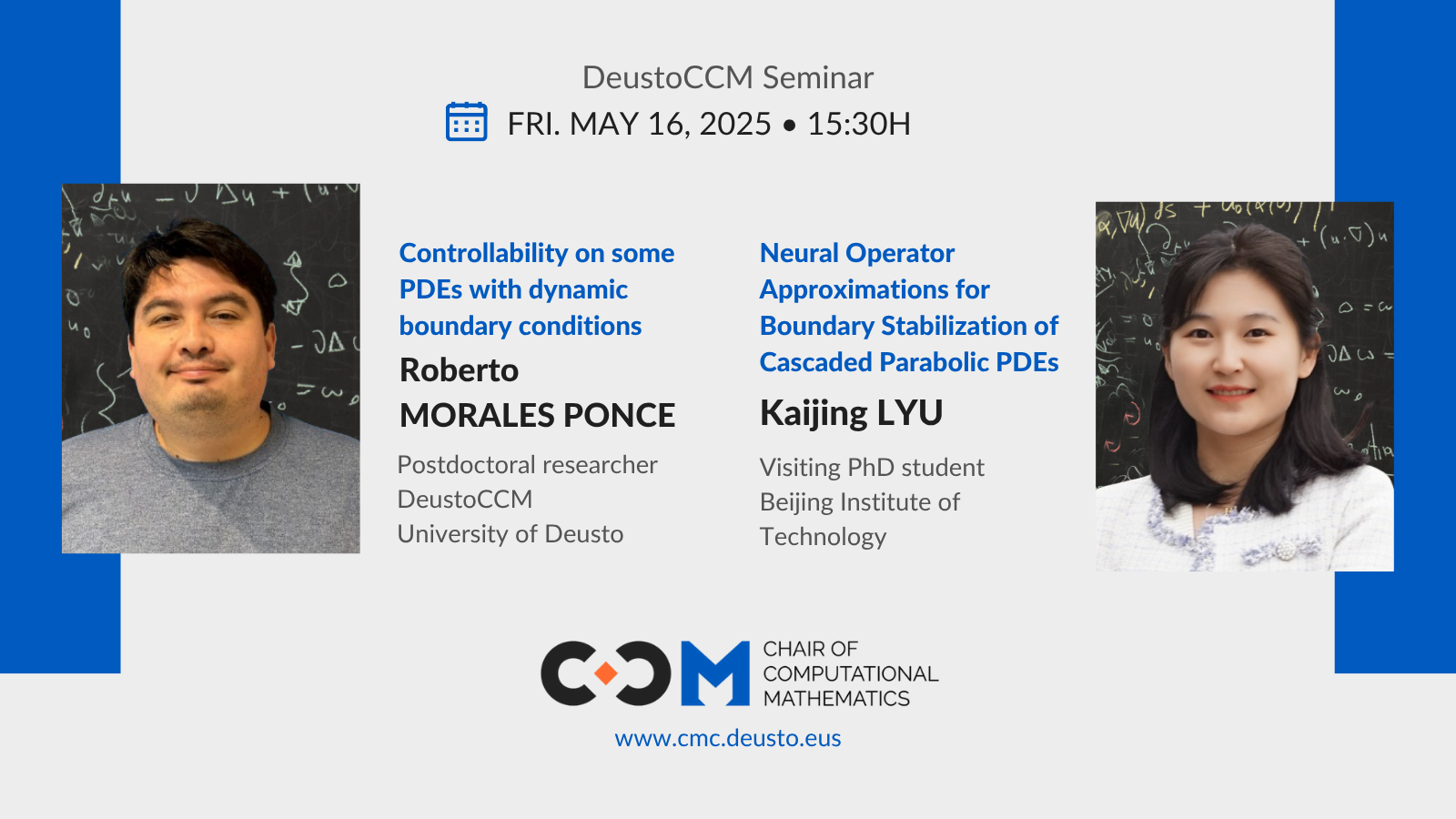
DeustoCCM Seminar by R. Morales and K. Lyu
Date: Fri. May 16, 2025 (15:30H)
Event: DeustoCCM Seminar
15:30H. Session 01
Title: Controllability on some PDEs with dynamic boundary conditions
Speaker: Prof. Roberto Morales
Affiliation: DeustoCCM, University of Deusto
Abstract. In this talk, I will present recent controllability results for partial differential equations (PDEs) with generalized dynamic boundary conditions. These findings primarily concern parabolic and dispersive equations. The proofs are based on well-known techniques based on the duality between Controllability and Observability of the associated adjoint system. I will also highlight several open problems that arise in this framework. Finally, I will outline some of the research directions I plan to pursue at DeustoTech, focusing on the intersection of Control Theory and Machine Learning.
16:00H. Session 02
Title: Neural Operator Approximations for Boundary Stabilization of Cascaded Parabolic PDEs
Speaker: Kaijing Lyu
Affiliation: Visiting PhD student at DeustoCCM
Abstract. The backstepping method has been widely applied to boundary control problems of PDE systems, but solving the backstepping kernel function can be time-consuming. To address this challenge, a neural operator (NO) learning scheme is leveraged to accelerate the control design for cascaded parabolic PDEs. DeepONet, a class of deep neural networks designed for approximating nonlinear operators, has demonstrated its potential in approximating PDE backstepping designs in recent studies. Specifically, we focus on approximating the gain kernel PDEs for two cascaded parabolic PDEs. We employ neural operators to approximate only two kernel functions, while the remaining two are computed analytically, thereby simplifying the training process. We establish the continuity and boundedness of the kernels and demonstrate the existence of arbitrarily close DeepONet approximations to the kernel PDEs. Furthermore, we show that the DeepONet-approximated gain kernels ensure stability when replacing the exact backstepping gain kernels. Notably, the DeepONet operator achieves computational speeds that are two orders of magnitude faster than PDE solvers for such gain functions, and its theoretically proven stabilizing capability is validated through simulations.
WHERE
University of Deusto, DeustoTech.
Room: Logistar
Unibertsitate Etorb., 24, 48007 Bilbao, Bizkaia
Date
- Fri 16th May 2025
- Expired!
Time
- 15:30 - 16:30
Location
- Unibertsitate Etorb., 24, 48007 Bilbao, Bizkaia

Organizer
-
DeustoCCM - Chair of Computational Mathematics
-
Phone
+34 94 413 9003 -
Website
https://cmc.deusto.eus