
Authors: Kang Liu, Ziqi Wang, Enrique Zuazua
A shared AI model needs more than a way to exchange updates: it needs participants willing to do the work. Our CoDeFeL research [1] shows how a small change in incentives can reshape their collective decisions—and, under suitable conditions, trigger a large jump in effort.
Sharing a model is not the same as sharing the work
Imagine a smartphone helping to improve a text-prediction model without sending its messages to a central database. It trains a local copy and sends model updates to a coordinator, which combines updates from many devices. This is the idea of federated learning [2]: bring learning to the data instead of bringing all the data to one place. Keeping raw records local reduces the need to share them, although model updates can still reveal information unless additional safeguards are used.
Now look at the same arrangement from the phone owner’s perspective. Training uses battery power, computing time, and communication resources. An owner with spare device capacity may agree to more training; another may prefer to do the minimum. These participating devices are called clients. The coordinator can ask for more work, but why should every client agree?
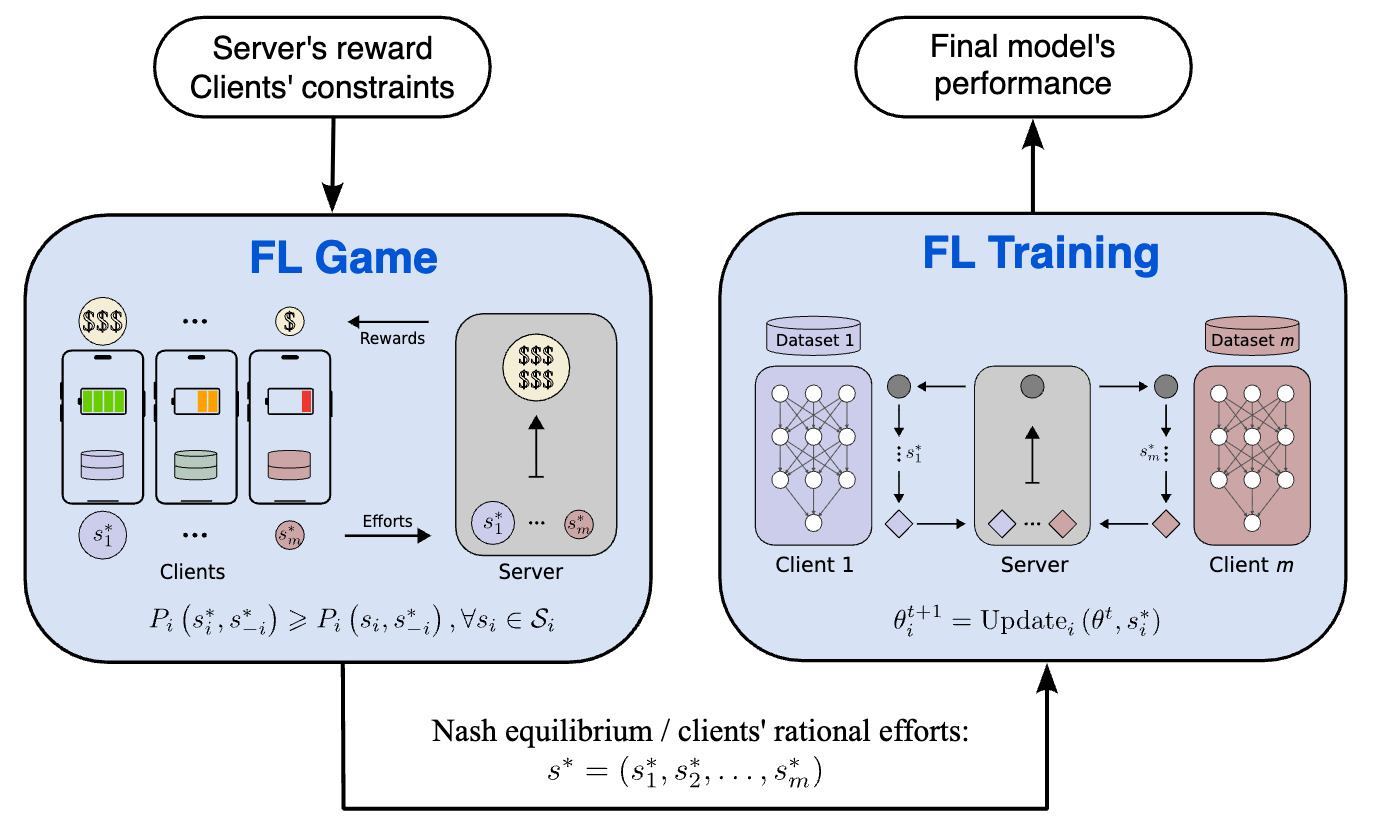
Figure 1: The incentive layer and the learning layer. On the left, each modeled client balances the server’s reward against its cost and workload limits. The resulting equilibrium efforts set the local workloads for training on the right; updates are aggregated into a shared model whose performance is then evaluated. Source: [1].
From a learning protocol to a game
Our model treats clients as self-interested players. Each chooses its training effort, measured in epochs: passes through its local data. The proposed reward resembles a team bonus: each client is paid for its own effort at a common unit rate. That rate rises with the group’s average effort, weighted by data size. A server-controlledreward factor sets the strength of this link.
For the analysis below, costs grow quadratically: doubling effort quadruples its modeled cost. Each client must do a positive minimum amount of training and has an upper workload limit. Thus, minimum effort means limited participation, not dropping out.
A Nash equilibrium is a consistent set of choices: no participant can improve its own reward minus cost by changing effort alone. It is not automatically fair or socially optimal; it describes individually rational behavior under the stated rules. The special structure of the reward makes this interaction a potential game [3]: every unilateral payoff improvement also moves uphill on one shared mathematical landscape.
A tipping point, not a smooth dial
We allow effort to vary continuously but keep each client’s choice fixed across rounds. In this stationary, quadraticcost model, three landmarks organize the response: activation, below which everyone does the minimum; a critical reward where a jump can occur; and saturation, beyond which everyone does the maximum.
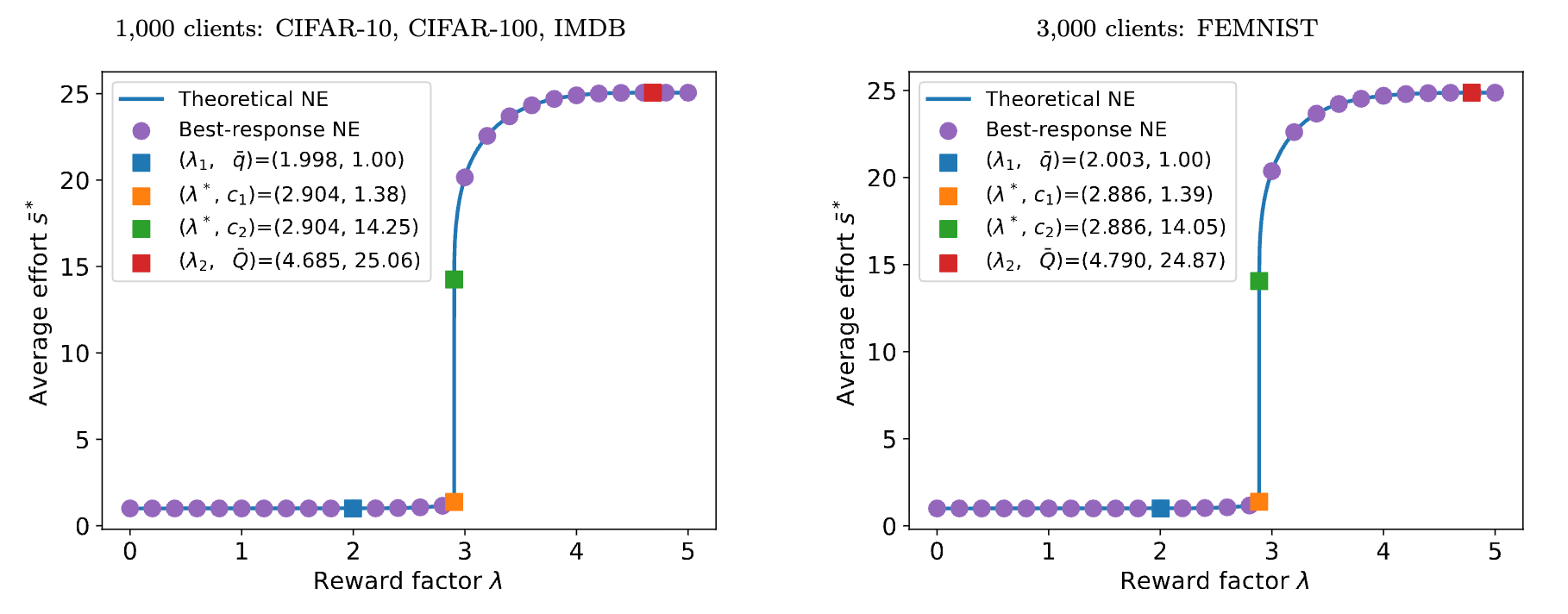
Figure 2: Average equilibrium effort versus reward factor in the two settings used for Figure 4. Blue curves give the theoretical equilibria; purple dots give best-response computations. Squares mark activation (\lambda_1), the jump endpoints (c_1,c_2 at \lambda^*), and saturation (\lambda_2). These endpoints differ from the Case 2 and Case 3 samples just before and after the jump. Source: [1]
Away from the critical reward level, there is exactly one equilibrium. At that level, infinitely many equilibria and a genuine jump occur if the workload limits admit a nonzero segment of the flat ridge described below; otherwise, the equilibrium remains unique. The three thresholds can also coincide, as in the identical-client example below.
Why the jump occurs: a hilltop becomes a ridge
Think of the potential as a landscape of everyone’s effort, not the AI model’s parameters. Costs bend it downward; shared rewards encourage clients to increase effort together. Below the critical reward, the landscape bends downward in every direction.
At the critical level, these effects balance in one direction, creating a flat ridge. Moving along it leaves the potential unchanged. Every point on this ridge within all clients’ workload limits maximizes the potential and is an equilibrium.
A two-client view of the landscape
The geometry is especially clear in a toy example with two identical clients. Each chooses an effort between one and five, with cost equal to effort squared. Below the critical reward factor 4/3, both choose one. At 4/3, any common effort between one and five is an equilibrium: the maximum extends along the diagonal ridge. Above it, both choose five.
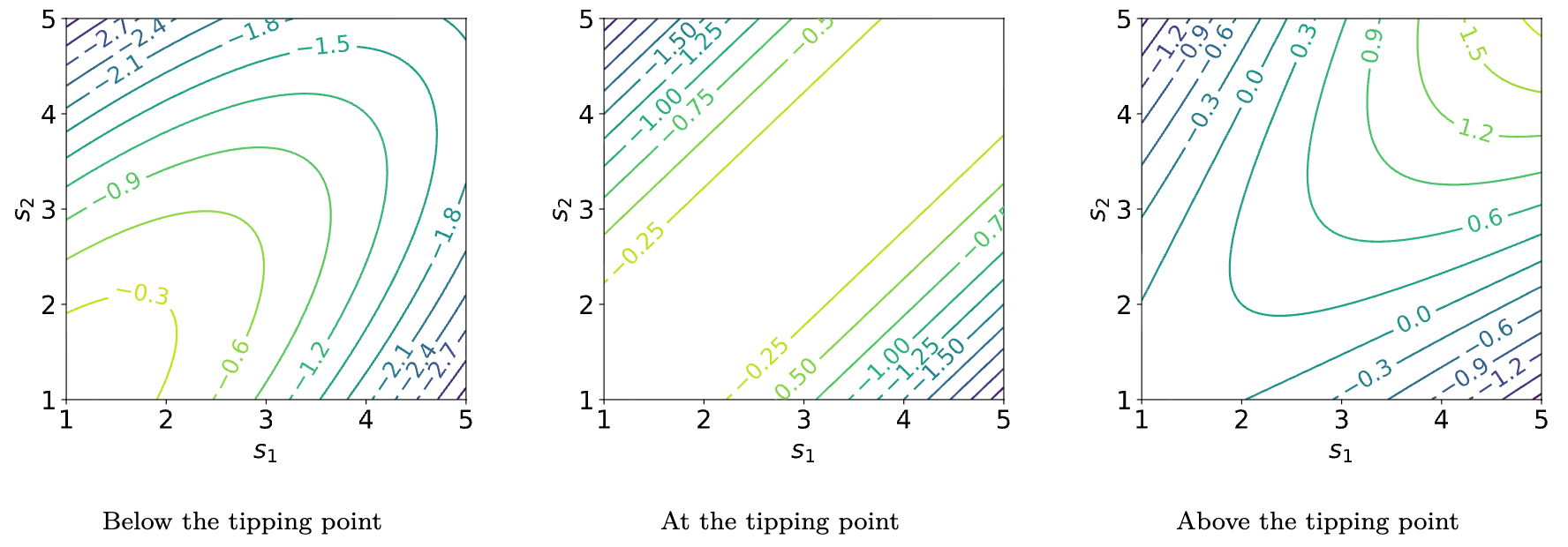
Figure 3: Potential contours for the two-client example. The axes show the clients’ efforts s1 and s2; contour numbers are potential values. The middle panel’s diagonal ridge consists entirely of equilibria. The outer panels each have one maximum. Source: [1].
Does more willingness to train improve the model?
The theory predicts effort, not accuracy. We therefore used the computed equilibrium efforts in 200-round training experiments with two standard methods, FedAvg and FedProx. The tasks were image classification (CIFAR-10 and CIFAR-100), movie-review sentiment analysis (IMDB), and handwritten-character recognition (FEMNIST), with heterogeneous client data.
Each selected client trained for its equilibrium effort rounded up to a whole number of epochs. Only a sample trained in each round: 10% of 1,000 clients for CIFAR and IMDB, or 1% of 3,000 for FEMNIST. These are computational experiments with modeled effort choices, not a trial measuring real users’ responses to payments.
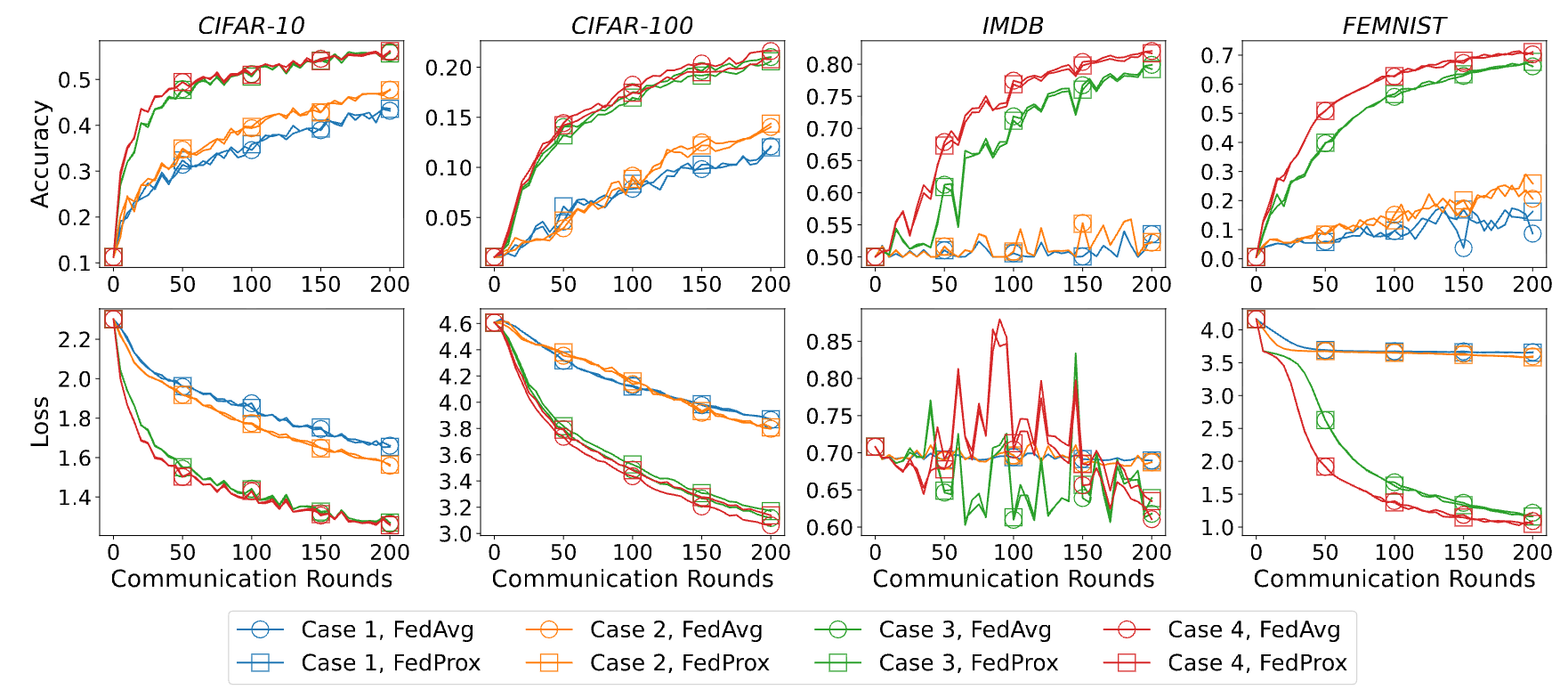
Figure 4: Federated-learning performance under four equilibrium regimes: before activation (Case 1), just before the jump (Case 2), just after the jump (Case 3), and after saturation (Case 4). Across the tested datasets and algorithms, the largest improvement occurs from Case 2 to Case 3. The upper row shows test accuracy and the lower row shows test loss (lower is better). Source: [1].
In the 1,000-participant setting, changing the reward factor from 2.90 to 2.91 crosses the predicted threshold of about 2.904. Average equilibrium effort, before rounding, rises from 1.32 to 16.41 epochs. Test accuracies, averaged across FedAvg and FedProx, rise from 47.7% to 55.8% on CIFAR-10, from 14.2% to 20.8% on CIFAR-100, and from 52.3% to 79.6% on IMDB.
In the 3,000-client FEMNIST setting, increasing the reward factor from 2.88 to 2.89 crosses its own threshold of about 2.886. Average test accuracy rises from 23.2% to 66.5%. Saturation brings smaller gains: for example, CIFAR-10 reaches 56.1% with an average equilibrium effort of 25.05 epochs [1, Table 2].
The same model captures the activation–jump–saturation pattern for both 1,000 and 3,000 clients (Figure 2), with theory and best-response computations agreeing. This supports the pattern’s robustness across these two population sizes: thresholds shift, but the mechanism persists. Broader deployment robustness remains to be tested.
A guide for incentives, not a universal recipe
The practical lesson is to look for sensitive regions in an incentive system. Reward factors just above a calibrated jump point are candidates for testing, not proven budget-optimal choices. A small change in the reward factor need not mean a small spending increase: payments also grow with collective effort.
These experiments illustrate, rather than guarantee, the effort–accuracy link. Other reward or cost rules may behave differently, and the model does not measure data usefulness. Data-aware rewards that adapt as training progresses remain an important next step. Sharing updates makes collaboration possible; understanding incentives explains why participants might do more of the work.
This work was supported in part by the European Research Council through the CoDeFeL project (grant agreement No. 101096251).
References
[1] K. Liu, Z. Wang, and E. Zuazua, Nonlinear Equilibrium Transitions in a Potential Game Model for Federated Learning, Physica D: Nonlinear Phenomena, 495 (2026), 135288. doi:10.1016/j.physd.2026.135288. Code and experiments.[2] H. B. McMahan et al., Communication-Efficient Learning of Deep Networks from Decentralized Data, AISTATS, PMLR 54 (2017), pp. 1273–1282.
[3] D. Monderer and L. S. Shapley, Potential Games, Games and Economic Behavior, 14 (1996), pp. 124–143.