
|
|
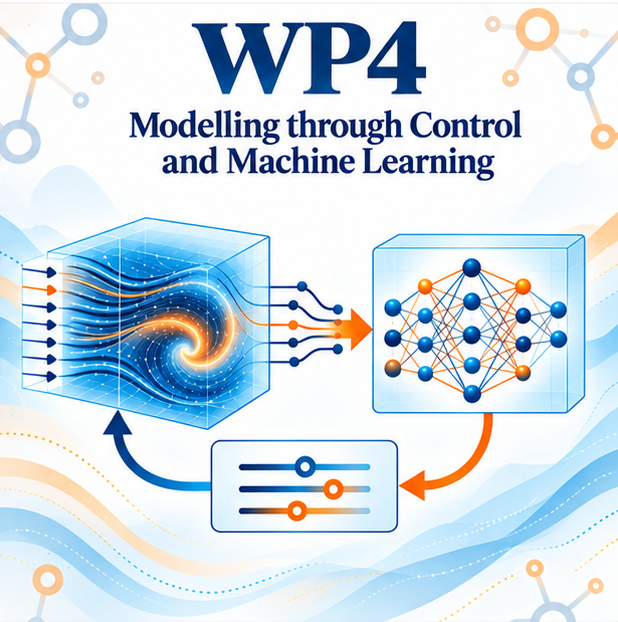
WP4 – Modelling through Control and Machine Learning Control theory provides a principled framework for regulating dynamical systems, while Machine Learning enables complex patterns and predictive models to be extracted from data. By integrating these two fields, we develop efficient, robust, and adaptive methodologies that combine data-driven learning with feedback mechanisms. This synergy provides a foundation for systems capable of adapting their behavior in real time while maintaining reliable performance in dynamic and uncertain environments. Discover our research tasks and outcomes in terms of publications and computational code for this working package. |
Research tasks
• Task 4.1 – Learning unknown physics from observations. Physical models often contain parameters or mechanisms that cannot be measured directly. By combining observed data with ODE/PDE models and optimization, these unknown components can be identified while preserving the underlying physical description of the system.
• Task 4.2 – Building models when the equations are unknown. Sometimes there is enough data to observe a system, but not enough knowledge to write down the equations governing it. ResNets can then act as surrogate dynamical models, reconstructing continuous trajectories from discrete observations and generating synthetic data describing possible evolutions.
• Task 4.3 – Combining physics and Machine Learning. Physics-based models provide structure and interpretability, while Machine Learning can capture information that the equations miss. Hybrid PDE-Machine Learning models combine these two sources of knowledge, allowing data and physical laws to correct and complement each other.
Publications
• K. Liu & E. Zuazua (2026). Moments, Time-Inversion and Source Identification for the Heat Equation. Inv. Problems, 42(1), 015009. arXiv:2507.02677
• K. Lyu, U. Biccari & J.-M. Wang (2026). Operator learning for prescribed-time stabilization of reaction-diffusion systems. Submitted. arXiv:2602.23157
• E. Zuazua (2026). The Coercivity Gap in Neural PDE solvers: parameter escape and functional convergence. Submitted. arXiv:2606.04018
• K. Liu & E. Zuazua (2026). A PDE Perspective on Generative Diffusion Models. Submitted. arXiv:2511.05940
• L. Liverani & E. Zuazua (2026). HYCO: A Formalism for Hybrid-Cooperative PDE Modelling. Submitted. arXiv:2602.23859
• U. Biccari, J. Chen, R. Morales & E. Zuazua (2026). Bi-HYCO: Bi-Objective Cooperative Learning for PDE Parameter Identification under Fragmented Observations. Submitted. arXiv:2609.06511
• J. Chen, U. Biccari & J.-M. Wang (2026). Learning the Riccati solution operator for time-varying LQR via Deep Operator Networks. Submitted. arXiv:2604.18507
• K. Liu & E. Zuazua (2026). Geometric Asymptotics of Score Mixing and Guidance in Diffusion Models. Submitted. arXiv:2605.12231
• Z. Li, K. Liu, Y. Song, H. Yue & E. Zuazua (2025). Deep Neural ODE Operator Networks for PDEs. Math. Models Methods Appl. Sci., 36(08), 1739-1782. arXiv:2510.15651
• M. Hernández & E. Zuazua (2025). Random Batch Methods for Discretized PDEs on Graphs. Submitted. arXiv:2506.11809
• K. Lyu, U. Biccari & J.-M. Wang (2025). Robust stabilization of hyperbolic PDE-ODE systems via Neural Operator-approximated gain kernels. Submitted. arXiv:2508.03242
• S. Jin, C. Ma & E. Zuazua (2025). Transmutation based Quantum Simulation for Non-unitary Dynamics. Submitted. arXiv:2601.03616
• Q. Lü, B. Ma & E. Zuazua (2025) Mean-Square Stability of Continuous-Time Stochastic Model Predictive Control . Submitted. arXiv:2512.03516
CoDeFeL GitHub – WP4
• U. Biccari, J. Chen, R. Morales & E. Zuazua. bi-HYCO: Cooperative PDE learning with fragmented observations
• J. Chen & U. Biccari. Riccati solution via DeepONet
• K. Lyu & U. Biccari. DeepONet for the stabilization of reaction-diffusion systems
• K. Lyu & U. Biccari. DeepONet for the stabilization of stochastic PDE-ODE systems
• Z. Li, K. Liu, L. Liverani & E. Zuazua. Semi-autonomous Neural ODEs
• L. Liverani, M. Steynberg & E. Zuazua. HYCO: The hybrid-collapse strategy for PDEs